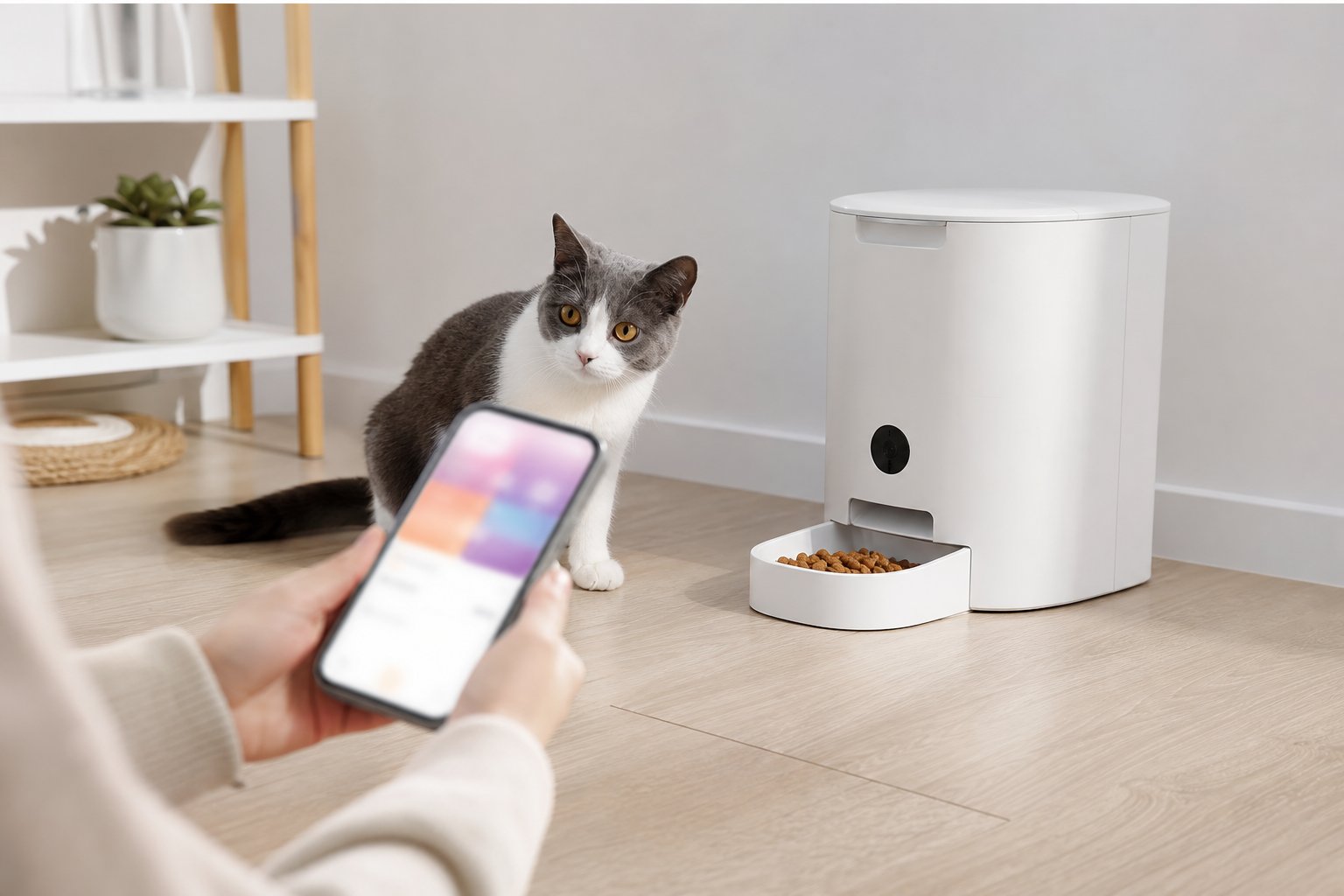
Tuya or a Custom App? The OEM Buyer's Decision Guide for Smart Pet Products
- The app decision is a brand decision made at purchase-order time — it fixes who controls OTA updates, who owns user data, and whose brand the customer remembers.
- The platform route is real and mature: Tuya's official one-stop pet solution spans smart feeders, treat dispensers and laser toys — hardware module plus embedded SDK plus app plus cloud/SaaS (tuya.com).
- The custom route no longer means reinventing hardware: Espressif's ESP32-C3/S3/P4 line plus the ESP RainMaker cloud has commoditized the chip layer, so "custom" means owning the top layer — UX, accounts, data.
- Whichever path you take, write three things into the cooperation agreement: the account system, the OTA sign-off cadence, and user data ownership with an export format.
- Rule of thumb: marketplace validation runs happily on a platform app; brand building across multiple SKUs earns its custom app.
Ask a factory for a smart feeder and you will eventually face a question that has nothing to do with kibble: which app does it talk to? Buyers often treat that as an IT line item and let the supplier decide. It is closer to a corporate decision — the answer determines whether firmware updates happen on your schedule or someone else's, whether the user database is an asset you hold or a record someone else keeps, and whether five years from now your customers remember your brand or a platform's.
This guide compares the two routes across five dimensions, looks at what the chip layer actually costs today, lists the contract clauses that decide who wins later, and maps each path to a company stage.
Two paths, five dimensions
The comparison is honest on both sides: each route buys something real, and each charges for it somewhere else.
| Dimension | Platform app (Tuya-type) | Custom app + cloud |
|---|---|---|
| Development cost | Lowest upfront engineering spend; module-plus-platform commercial model | Higher upfront: app development, backend build, ongoing maintenance shifts to you |
| Time to market | Fastest — mature reference designs and a finished, store-reviewed app | Longer — app store review cycles, backend hardening, QA across OS versions |
| OTA control | Platform-managed cadence; you schedule within platform rules | Full control: your cadence, your testing gate, your rollback plan |
| User data ownership | Accounts and telemetry structured inside the platform cloud; contractual clarity required | Yours by default — the cloud tenant is yours; still write it down |
| Brand accumulation | Shared ecosystem identity; OEM customization (naming, splash) within platform scope | Complete brand surface: name, icon, splash screen, onboarding, store presence |
Table 1 — The two app routes across five buyer-relevant dimensions.
The platform option is not a compromise product — it is a mature industry. Tuya maintains a dedicated one-stop pet solution line covering IPC-based smart feeders, treat dispensers and laser toys, chaining the hardware module, embedded SDK, app and cloud/SaaS into a single offering (Tuya official pet solutions). For a buyer shipping one validated SKU quickly, that completeness is the product.
What the platform route actually buys — and what it defers
What you buy is speed and certainty: proven modules, a finished app that has already survived app-store review, and a cloud that scales without your involvement. For a marketplace seller validating demand at 100–500 units, that is exactly the right tool.
What you defer is threefold. OTA rhythm: fixes and feature updates follow the platform's cadence and policies, not your release plan. Data: accounts and device telemetry live in the platform's account structure — workable, but only as strong as what your contract says about it. Brand: the customer's app experience belongs to the platform's ecosystem, with OEM customization (naming, splash screens) inside a defined scope. None of these is a defect; all three are costs that arrive later, which is precisely why they should be priced into the first purchase order rather than discovered in the second year.
What "custom" means now — the chip layer is solved
The strongest argument against custom apps used to be cost, and the chip industry has been dismantling it. Espressif's ESP32 line now tiers the work cleanly: the ESP32-C3 covers basic Wi-Fi connected feeding; the ESP32-S3, with vector instructions for on-device neural processing, handles voice and image features; the ESP32-P4 targets higher-performance AI vision. Around the silicon sits the ESP RainMaker cloud and open app components, so firmware and account infrastructure start from a working baseline (Espressif official product documentation).
Translated for a buyer: a custom app is no longer a moonshot; it is a product-management commitment. The hardware layer is commodity. What you actually commission is the top layer — the user experience, the account system, the data policy — which is exactly the layer that compounds into brand value. On our OEM/ODM program, both paths ship with the same private-label surface: app naming, splash-screen customization, firmware OTA configured to your release rhythm.
Custom also answers a risk the platform route only mitigates: supplier continuity. The industry's publicly documented funding-failure case — a well-capitalized smart-pet startup that wound down and took its cloud with it — turned thousands of connected devices into desk ornaments. Whoever runs your backend must outlive your vendor relationship, or your contract must define what happens when it does not.
The clauses that decide who wins later
Whichever route you choose, the protection lives in the cooperation agreement, not in the architecture. Five clauses carry the weight:
- Account system ownership. Name whose tenant the accounts live in, and who may migrate or export them. This single sentence decides your leverage in every later negotiation.
- OTA cadence and sign-off. Who tests a firmware release, who approves it, who pushes it, and what the rollback plan is. In the custom route this is yours by design; in the platform route, define your slot in the platform's process.
- Data ownership and export format. User data ownership stated explicitly, plus a defined export format — the clause that makes a future migration possible at all.
- App identity assets. App name, icon, splash screen and store listings owned by your entity, whether built on or off a platform.
- Exit and continuity. If the relationship ends: what happens to the cloud, the accounts, the firmware sources. An hour of drafting here prevents a graveyard of bricked devices.
Migration is the hidden cost of the app decision. Switching platforms — or graduating from a platform to your own app — means moving user accounts, re-pairing devices in living rooms and rebuilding OTA pipelines; users who do not migrate lose remote features. If any switch is even possible on your roadmap, negotiate the exit clauses before the first purchase order, while you still have maximum leverage.
Which path at which scale
Map the decision to where the company actually is:
| Stage | Typical volume | Recommended path | Why |
|---|---|---|---|
| Marketplace validation | 100–500 stock-label units | Platform app | Speed and low commitment; demand is still unproven |
| First custom OEM line | 500–5,000 units | Platform-first, contract the exit | Keep the speed; secure data scope, export format and migration terms in writing |
| Brand across SKUs | 5,000+ units, multiple categories | Custom app + cloud | One account system, one brand surface; user data compounds across products |
| Premium positioning | Any volume, premium tier | Custom app + cloud | Data ownership and privacy become part of the product story |
| Gift & retail programs | Seasonal, channel-driven | Platform app | Simplicity for channel partners; short product cycles |
Table 2 — App-path guidance by company stage. Volumes reference our published MOQ tiers (stock-label from 100 units, custom from 500).
Note that the two middle rows are a sequence, not a contradiction: the most common successful path we see is platform-first with the exit contractually secured, graduating to a custom app when the brand earns one. The failure mode is not choosing either path — it is choosing implicitly, by not deciding at all.
Frequently asked questions
Can we launch on a platform app and switch to our own later?
Technically yes, and it is a common sequence. But migration is the hidden cost: user accounts must move, devices in customers' homes must re-pair, OTA pipelines rebuild — and users who do not migrate lose remote features. If a switch is even possible on your roadmap, negotiate data export, account portability and cloud tenancy in the first agreement, not after launch.
Who owns the user data under each path?
Platform route: accounts and telemetry are structured inside the platform's cloud, so your ownership is the sum of the platform's terms and your supplier contract — put data scope and export rights in writing. Custom route: yours by default, since the cloud tenant is yours — write it down anyway, including the export format. In both cases the contract, not the architecture, is what protects you.
Is a custom app only for large brands?
No. The chip layer is commoditized — Espressif ships Wi-Fi modules with cloud services and open app components — so a custom route can start as an MVP: scheduling, notifications, OTA, a feeding log. The real cost is ongoing maintenance rather than the initial build, so the decision is about brand ambition and multi-SKU plans, not headcount.
What hardware platforms do your feeder and camera products build on?
Feeders scale across the Espressif ESP32 family: ESP32-C3 for connected feeding, ESP32-S3 for on-device voice or image features, ESP32-P4 for AI vision. Camera categories use mature IPC platform solutions. Both app paths are supported — platform apps such as Tuya's pet solutions, or a custom app with your own account system and OTA rhythm.